 FREE SHIPPING! Automatically Applied on Orders Over $74!



You can eat pomegranates every single day and still get none of the compound they're best known for.
Whether you produce it comes down to which bacteria happen to live in your gut. For some people the conversion works reasonably well. For others it barely happens at all, and a portion of the population can't do it whatsoever, no matter how well they eat.
The compound is urolithin A, and over the past decade it's become one of the most closely studied molecules in longevity research. Unlike many trending ingredients, it now has a real and growing body of human clinical data behind it, including new trials published in 2024 and 2025.
Here's what urolithin A is, how it works, what the research actually shows, and who might consider it.
What Is Urolithin A?
Urolithin A is a postbiotic, a compound your gut bacteria produce, rather than one you eat directly.
It starts with ellagitannins, polyphenols found in urolithin A natural sources like pomegranates, walnuts, almonds, strawberries, and raspberries. These polyphenols aren't absorbed intact. Instead, they're broken down in the gut to ellagic acid, which certain gut bacteria then convert into urolithins, including urolithin A.
That conversion step is where things get interesting.
Why Some People Make It and Others Don't

Not everyone's gut microbiome can perform this conversion efficiently. Research indicates that the ability to produce urolithin A varies considerably from person to person, tends to decline with age, and is absent altogether in a portion of the population.
There's a further wrinkle: even among people whose microbiome can make the conversion, the process is incomplete and unpredictable, and it becomes less efficient with age. So this isn't a simple matter of converters and non-converters, it's a spectrum, and most people sit somewhere in the middle without any practical way of knowing where.
This means two people can eat the same pomegranate and end up with very different levels of urolithin A in circulation. It's a good example of why personalized nutrition matters: dietary advice that works beautifully for one person may not translate for another, depending on what their microbiome can do with the food.
With supplemental urolithin A, you don’t have to worry about whether or not your microbiome will convert ellagitannins to urolithin A. Supplemental urolithin A goes straight into your bloodstream, no gut bacteria required.
How Urolithin A Works: Mitophagy and Mitochondrial Renewal

Mitochondria are the energy-producing structures inside your cells, often called the cell's powerhouses. They're present in nearly every cell, but muscle cells are especially dense with them, because muscle has such high energy demands.
Over time, mitochondria accumulate damage and become less efficient. Your cells have a built-in quality-control process for this, called mitophagy: damaged mitochondria are identified, broken down, and recycled, making room for new, healthy ones. Like most maintenance processes, mitophagy becomes less efficient with age.
A quick distinction worth knowing: autophagy, literally "self-eating", is the general process by which cells break down and recycle their own components. Mitophagy is the specific version that applies to mitochondria. Urolithin A is notable for targeting the latter.
Urolithin A works primarily by supporting mitophagy. Research suggests it helps the body clear out dysfunctional mitochondria while supporting mitochondrial biogenesis, the creation of new ones. The net result is a mitochondrial population that works more efficiently.
This mechanism is what distinguishes urolithin A from a typical antioxidant. Rather than neutralizing free radicals, it supports the cell's own renewal machinery.
What the Research Shows
Does mitopure really work?
Urolithin A has been studied in humans for over a decade. Most clinical trials have used Mitopure®, the Amazentis proprietary form of urolithin A developed specifically for research and supplementation.

Muscle Strength and Endurance
This is the best-established area of research.
In a randomized, double-blind, placebo-controlled trial in middle-aged adults (ages 40 to 64), four months of daily urolithin A supplementation was associated with roughly a 12% improvement in muscle strength compared with placebo, along with improvements in aerobic endurance and physical performance.
An earlier randomized trial in older adults found that urolithin A supplementation supported muscle endurance and markers of mitochondrial health.
More recently, an eight-week randomized, double-blind, placebo-controlled study in resistance-trained male athletes examined effects on muscle endurance, strength, inflammation, and protein metabolism, extending the research beyond older and sedentary populations into trained athletes.
Cellular Energy and Healthy Aging
Across trials, urolithin A supplementation has been associated with favorable changes in biomarkers of mitochondrial efficiency, including plasma acylcarnitines, and with lower levels of C-reactive protein, a marker of inflammation.
Because mitochondrial function underlies energy production throughout the body, this is the mechanism behind most of the compound's reported benefits, from stamina and physical performance to general vitality.
Immune Function
One of the most notable recent developments came in late 2025, when a randomized, placebo-controlled trial published in Nature Aging examined urolithin A's effects on age-related immune decline. Immune cells depend heavily on mitochondrial function, and this connection has historically received less attention than the muscle research.
Emerging Areas
Preclinical and animal research is exploring urolithin A's role in brain and cardiovascular health, with early findings around mitochondrial resilience in cardiac tissue. These are promising directions, but they haven't yet been tested in human clinical trials, and they're best treated as hypotheses rather than established benefits.
Who Might Consider Urolithin A?
Based on the current evidence, urolithin A may be worth discussing with a practitioner if you're:
Over 40 and noticing changes in energy or strength. Muscle mass begins declining gradually from around age 30, and this is the population where the strongest clinical data exists.
Physically active and focused on performance or recovery. The mitochondrial efficiency angle is relevant for endurance and for recovery between demanding training sessions.
Focused on healthy aging generally. Mitophagy is a foundational cellular process rather than a symptom-specific intervention, which makes it a reasonable place to start.
Unsure whether you convert ellagitannins efficiently. If you eat plenty of pomegranates, walnuts, and berries but wonder whether you're getting the benefit, direct supplementation removes that variable.
As always, this doesn't replace the fundamentals. Exercise remains the most powerful intervention for mitochondrial health, supplementation supports that work rather than substituting for it.
How Much Urolithin A Per Day?
This is where it's worth reading labels carefully, because serving sizes vary and the number that matters is the daily total.
The human trials discussed above used daily doses of 500 mg and 1,000 mg of Mitopure® urolithin A over four months. Benefits were observed at the 500 mg dose, which is the amount most commonly referenced as the clinically studied level.
That matters practically. A product providing 250 mg per serving reaches the studied dose at two servings daily, not one. If you're evaluating urolithin A products, compare the daily total rather than the per-capsule amount, it's the single most common source of confusion in this category.
Timing appears to be flexible. Urolithin A supports a cellular process rather than producing an acute effect, so consistency over months matters considerably more than when in the day you take it.
What Urolithin A Costs, and Why
Urolithin A is more expensive than most supplements, and it's worth understanding why rather than being surprised at checkout.
It isn't extracted from fruit. Because dietary ellagitannins only become urolithin A through unreliable bacterial conversion, the clinically studied forms are produced through a controlled manufacturing process that yields the finished compound directly. That process, plus the cost of the human trials behind it, is reflected in the price.
Two things help when evaluating whether it's worth it:
Compare cost per day at the studied dose, not cost per bottle. A cheaper product at half the daily dose isn't cheaper, it's a different thing.
Be clear about what you're buying. A pomegranate extract supplies ellagitannins and depends on your microbiome to do the rest. The best urolithin A supplement supplies the finished compound. With urolithin A for sale everywhere now, from Celltrient to practitioner formulas, those are genuinely different products at genuinely different prices, and the label language can make them look similar.
A Practitioner-Grade Option
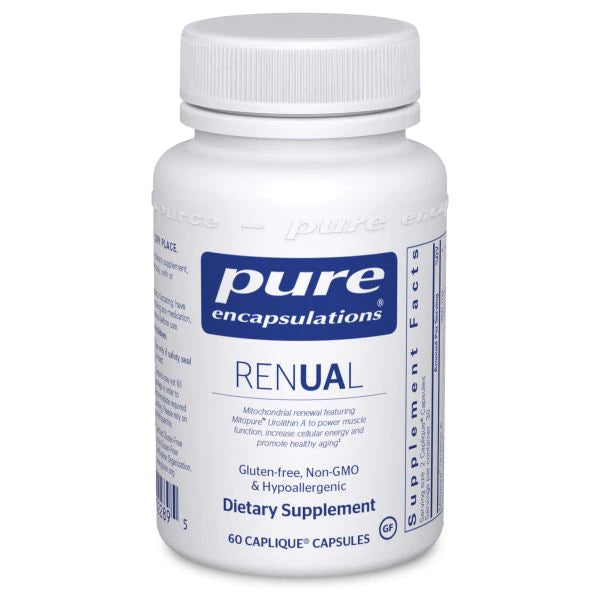
Our nutrition experts recommend Pure Encapsulations RENUAL. Each two-capsule serving provides 250 mg of Mitopure® urolithin A, 150 mg trans-resveratrol (from Japanese knotweed root), and 60 mg coenzyme Q10. Suggested use is two capsules, one to two times daily, with or between meals, meaning two servings daily corresponds to the 500 mg dose used in clinical research.
The formula pairs three ingredients that act on the same system from different angles. Urolithin A supports mitophagy, clearing out damaged mitochondria. Resveratrol acts on SIRT1, a protein involved in the cellular pathways associated with caloric restriction and exercise. CoQ10 plays a direct role in the mitochondrial energy production chain and provides antioxidant support. Together they address mitochondrial renewal, signaling, and function rather than any one piece in isolation.
RENUAL is certified gluten-free and, like all Pure Encapsulations formulas, is free from common allergens, unnecessary additives, and GMOs, consistent with the standards we look for in the practitioner brands we carry.
Because urolithin A is still a relatively new supplement category and individual needs vary, we recommend talking with a qualified practitioner before starting, particularly if you take medications or are managing an ongoing health concern. Our team can help you determine whether urolithin A makes sense alongside the rest of your routine. Book a consultation with one of our nutrition experts.
Key Takeaways
Urolithin A is a postbiotic produced when gut bacteria break down ellagitannins from pomegranates, walnuts, berries, and almonds, which are the usual dietary sources of urolithin A precursors.
Not everyone produces it efficiently. The ability varies between individuals, declines with age, and is absent entirely in some people, and even among those who can convert, the process is incomplete and unpredictable.
Direct supplementation bypasses the conversion step and produces substantially higher blood levels than dietary sources alone.
It works by supporting mitophagy, the cellular process that clears out damaged mitochondria and makes room for new ones.
So far, human clinical trials link urolithin A supplement benefits to enhanced muscle strength and endurance, as well as increased efficiency in cellular mitochondria (a topic that’s been getting some recent attention in research on immune response).
Clinical trials used 500 mg and 1,000 mg daily; compare products on daily total rather than per-capsule amount.
Brain and cardiovascular applications remain at the preclinical stage.
Most clinical research has used Mitopure®, the form of urolithin A found in Pure Encapsulations RENUAL.
Frequently Asked Questions
What foods contain urolithin a?
Not necessarily. Urolithin A food sources like pomegranates, walnuts, and berries supply the ellagitannins, but your gut bacteria have to convert them. That conversion capacity varies widely between individuals and tends to decline with age, so eating the right foods doesn't guarantee you're producing meaningful amounts.
How much urolithin A should I take?
Human clinical trials have used 500 mg and 1,000 mg daily, with benefits observed at 500 mg. Because serving sizes differ between products, compare the daily total rather than the amount per capsule. Your practitioner can help you determine what's appropriate for your goals.
How long does it take to notice a difference?
The timeline for urolithin A in clinical trials has typically run four months at daily doses, with some measuring changes at eight weeks. This is a cellular-level process rather than a stimulant effect, so consistency over time matters more than any immediate sensation.
Is urolithin A the same as pomegranate extract?
No. Pomegranate extract supplies ellagitannins, the raw material, and the same is true of juice: any urolithin A in pomegranate juice still depends on your gut bacteria making the conversion. Urolithin A is the metabolite your gut bacteria produce from them. Supplementing with urolithin A directly skips the conversion step, which is why it works regardless of your microbiome composition.
Why are urolithin A supplements so expensive?
The clinically studied forms are produced through a controlled manufacturing process rather than extracted from fruit, because dietary ellagitannins only become urolithin A through unreliable bacterial conversion. That process, along with the human trials behind it, is reflected in the price.
When should I take urolithin A?
Timing appears flexible. Because it supports an ongoing cellular process rather than producing an acute effect, taking it consistently matters more than taking it at a particular time of day.
Is urolithin A safe?
Urolithin A has been well tolerated in clinical trials to date. As with any new supplement, check with your healthcare provider before starting, particularly if you're pregnant or nursing, taking medications, or managing an ongoing health concern.
How does urolithin A help mitochondria?
The primary mechanism of action for Urolithin A is to encourage mitophagy, which is the process where the cell detects, degrades, and removes old, malfunctioning mitochondria, leaving space for newer, healthier mitochondria to be generated. It appears that Urolithin A encourages the elimination of old mitochondria as well as stimulating biogenesis, the manufacturing of new mitochondria. Thus, the end result is a mitochondrial pool that operates more efficiently. It is not a typical antioxidant, because it supports the body’s own ability to renew its cells, rather than scavenging free radicals.
How much urolithin A is in pomegranate?
There’s no set dose of urolithin A listed for pomegranates in this article. It says that pomegranates provide the precursors, called ellagitannins, but not urolithin A itself. And the conversion of the precursors into urolithin A is dependent on the microbes in your gut, which vary from person to person, and seem to decrease with age. Thus, two people eating the same pomegranate may have wildly different amounts of urolithin A. To find out what works best for you, consult with a licensed health care professional.
Same with pomegranate juice. It also provides ellagitannins but not urolithin A. If your microbes can convert those ellagitannins to urolithin A, great. But they may not, or there may be too few of them, or you may lack them entirely, or your capacity to make them may decline as you age. So, two people can have the same glass of juice and have very different levels.
Where does urolithin A come from?
Urolithin A is a postbiotic. Unlike probiotics or prebiotics, it’s not something you eat, it’s something your gut bacteria create from what you eat. Specifically, urolithin A is derived from a group of plant chemicals called ellagitannins, which are abundant in pomegranates, walnuts, almonds, strawberries and raspberries. Your body converts ellagitannins into a related chemical called ellagic acid, which your gut flora turn into urolithins, including urolithin A. That final step doesn’t happen reliably enough for you to rely on these foods as a source of urolithin A. Instead, the clinically tested versions of the supplement are produced through a manufacturing process that creates urolithin A directly.
Why is urolithin A more expensive than other supplements?
The clinically studied forms are produced through a controlled manufacturing process rather than extracted from fruit, because dietary ellagitannins only become urolithin A through unreliable bacterial conversion. That process, along with the human trials behind it, is reflected in the price.
Can I get enough urolithin A from food?
Not necessarily. Pomegranates, walnuts, and berries supply the ellagitannin precursors, but your gut bacteria have to convert them. That conversion capacity varies widely between individuals and tends to decline with age, so eating the right foods doesn't guarantee you're producing meaningful amounts.
These statements have not been evaluated by the Food and Drug Administration. This product is not intended to diagnose, treat, cure, or prevent any disease.
sale
PURE ENCAPSULATIONS
Renual
1 review
$79.00
$79.00
Mitochondrial renewal featuring Mitopure Urolithin A to power muscle function, increase cellular energy and promote healthy aging.
Benefits & Features
Enhances mitochondrial renewal to support energy output/energy production
Powers healthy muscle function
Promotes healthy aging
Unique polyphenol metabolite
Exclusive first to market in Health Care Practitioner channel
References
- Singh A, D'Amico D, Andreux PA, et al. Urolithin A improves muscle strength, exercise performance, and biomarkers of mitochondrial health in a randomized trial in middle-aged adults. Cell Reports Medicine. 2022;3(5):100633.
- Liu S, D'Amico D, Shankland E, et al. Effect of urolithin A supplementation on muscle endurance and mitochondrial health in older adults: a randomized clinical trial. JAMA Network Open. 2022;5(1):e2144279.
- Zhao H, Zhu H, Yun H, et al. Assessment of Urolithin A effects on muscle endurance, strength, inflammation, oxidative stress, and protein metabolism in male athletes with resistance training: an 8-week randomized, double-blind, placebo-controlled study. Journal of the International Society of Sports Nutrition. 2024;21:2419388.
- Denk D, Singh A, Kasler HG, et al. Effect of the mitophagy inducer urolithin A on age-related immune decline: a randomized, placebo-controlled trial. Nature Aging. 2025;5(11):2309-2322.
- Mitopure™ (Proprietary Urolithin A) Bioavailability in Healthy Adults (NOURISH). ClinicalTrials.gov identifier NCT04160312.
Categories
Categories
Humanized Health - NEW!
Learn about personalized health from top experts! Check out our fascinating new shows every week, available as videos, podcasts and transcripts.:
Our Bloggers
-
 Paula Gallagher
Paula is a highly qualified and experienced nutrition counselor on the staff at Village Green.
read more.. -
 Margo Gladding
Margo's impressive knowledge base is the result of a unique blend of educational and professional experience.
read more.. -
 Dr. Neal Barnard
Dr. Barnard leads programs advocating for preventive medicine, good nutrition, and higher ethical standards in research.
read more.. -
 Dr. Joseph Pizzorno
Dr. Joseph Pizzorno, ND is a pioneer of integrative medicine and a leading authority on science-based natural medicine.
read more.. -
 Debi Silber
Debi is a registered dietitian with a master’s degree in nutrition, a personal trainer, and whole health coach.
read more..
SEE ALL OF OUR BLOGGERS
Invalid password
Enter


Stay Connected
Village Green Apothecary
5415 W Cedar Ln
Bethesda, Maryland, 20814
(301) 530-0800
Toll Free: (800) 869-9159
The information provided on this site is not intended to be a substitute for advice or treatment from a qualified physician, nor is it intended to diagnose or treat a health problem or disease. Consult your physician prior to starting any new health program or if you any questions regarding a medical condition.
© 2025 Village Green Apothecary - All Rights Reserved.
